
- Jim Corbett Safari Booking
- August 30, 2026
- 7:09 am
History of Jim Corbett National Park: From Hailey National Park to Today
Introduction
Jim Corbett National Park is one of India’s most famous wildlife destinations and holds a special place in the history of wildlife conservation. Located in the Nainital district of Uttarakhand, the park attracts thousands of visitors every year who come to enjoy wildlife safaris, nature photography, birdwatching, and forest adventures.
While many tourists visit the park for Jim Corbett Safari Booking, few know the fascinating story behind its creation. Jim Corbett National Park is not only India’s oldest national park but also an important milestone in the country’s wildlife conservation journey.
From its early days as Hailey National Park to becoming a globally recognized tiger reserve, the history of Jim Corbett National Park is filled with remarkable achievements and conservation efforts.
This article explores the complete history of Jim Corbett National Park and how it evolved into one of the most important protected wildlife areas in India.
The Natural Beauty of the Corbett Region
Long before the park was established, the forests of the Corbett region were known for their rich biodiversity and scenic landscapes.
The area consists of:
- Dense Sal forests
- Grasslands
- River ecosystems
- Hills and valleys
- Seasonal streams
The Ramganga River plays a major role in maintaining the ecological balance of the region.
For centuries, these forests provided habitat to a wide variety of wildlife species, including:
- Tigers
- Leopards
- Elephants
- Deer
- Crocodiles
- Hundreds of bird species
The ecological importance of this region eventually led to the idea of wildlife protection.
Who Was Jim Corbett?
Before understanding the park’s history, it is important to know about the man whose name the park carries.
Edward James Corbett
Jim Corbett was born in 1875 in Nainital.
He became famous as:
- A skilled hunter
- Naturalist
- Conservationist
- Author
During the early 20th century, Jim Corbett helped local communities by tracking and eliminating man-eating tigers and leopards that threatened villages in the Kumaon region.
Over time, he developed a deep respect for wildlife and became a strong supporter of forest conservation.
His contributions to wildlife awareness played a significant role in protecting the forests that would later become Jim Corbett National Park.
The Idea of Creating a Protected Area
During the early 1900s, wildlife populations across India were declining due to:
- Hunting
- Habitat destruction
- Human expansion
Conservationists and forest officials recognized the need to protect important wildlife habitats.
The forests around Ramnagar were considered ideal because of:
- Rich biodiversity
- Healthy wildlife populations
- Large forest coverage
- Natural ecological balance
These factors encouraged the government to establish a protected wildlife area.
Establishment of Hailey National Park
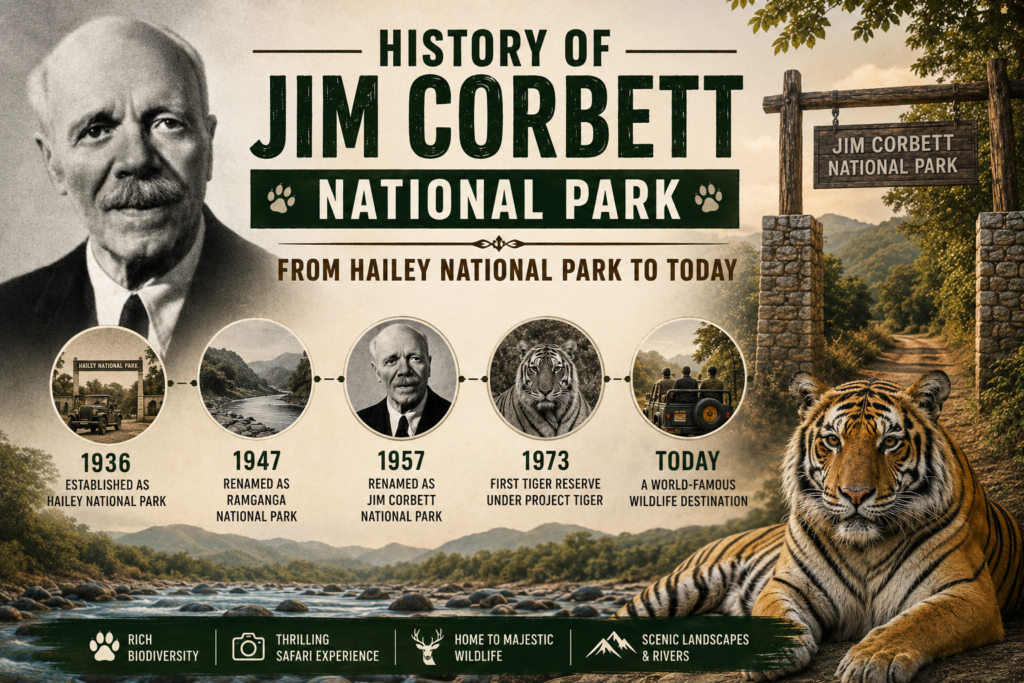
In 1936, the protected area was officially established as Hailey National Park.
It was named after Sir Malcolm Hailey, who was then the Governor of the United Provinces.
This was a historic achievement because:
Hailey National Park became India’s first national park.
The establishment of the park marked the beginning of organized wildlife conservation efforts in India.
The original protected area covered approximately 325 square kilometers.
Its primary objective was to preserve wildlife and natural habitats for future generations.
Why Hailey National Park Was Important
The creation of Hailey National Park represented a major shift in wildlife management.
Before this period:
- Hunting was common.
- Wildlife populations faced increasing pressure.
- Conservation laws were limited.
The establishment of the park introduced:
- Wildlife protection measures
- Habitat conservation
- Controlled human activities
- Scientific forest management
These efforts helped preserve one of India’s most valuable ecosystems.
Changes After India’s Independence
Following India’s independence in 1947, wildlife conservation policies gradually evolved.
The newly independent nation recognized the importance of protecting forests and wildlife resources.
As conservation awareness increased, efforts were made to strengthen wildlife protection throughout the country.
The former Hailey National Park continued to play an important role in these conservation initiatives.
Renaming to Ramganga National Park
After independence, the park underwent a name change.
For a period, it became known as Ramganga National Park, named after the Ramganga River that flows through the region.
The river is one of the most important ecological features of the park.
It supports:
- Wildlife habitats
- Aquatic ecosystems
- Grasslands
- Forest biodiversity
The Ramganga River remains one of the most iconic attractions within the park today.
Becoming Jim Corbett National Park
In 1957, the park was officially renamed Jim Corbett National Park.
The name change honored the contributions of Jim Corbett toward:
- Wildlife conservation
- Nature education
- Environmental awareness
His books, including:
- Man-Eaters of Kumaon
- The Man-Eating Leopard of Rudraprayag
- Jungle Lore
helped create global awareness about Indian wildlife and forests.
Today, Jim Corbett’s legacy continues to inspire wildlife conservation efforts across India.
Growth of Wildlife Conservation
During the decades that followed, wildlife conservation became increasingly important.
Forest authorities worked to:
- Protect habitats
- Reduce illegal hunting
- Improve wildlife monitoring
- Preserve biodiversity
These efforts contributed to healthier wildlife populations within the park.
As a result, Jim Corbett became one of India’s most successful conservation landscapes.
Launch of Project Tiger
One of the most significant milestones in the park’s history occurred in 1973.
India launched Project Tiger, a national wildlife conservation program aimed at protecting Bengal Tigers.
Jim Corbett became the first Tiger Reserve under Project Tiger.
This achievement made the park even more important on the global conservation map.
Project Tiger focused on:
- Habitat protection
- Anti-poaching measures
- Scientific monitoring
- Community participation
The program played a major role in tiger conservation throughout India.
Expansion of the Corbett Tiger Reserve
Over time, the protected area expanded beyond the original national park boundaries.
The larger conservation landscape became known as the Corbett Tiger Reserve.
Today, the reserve includes:
- Core protected areas
- Buffer zones
- Forest divisions
- Wildlife corridors
This broader approach helps maintain ecological connectivity and supports wildlife movement across the landscape.
Tourism and Safari Development
As awareness of wildlife tourism increased, Jim Corbett emerged as one of India’s leading safari destinations.
Visitors began arriving from across:
- India
- Europe
- North America
- Asia
Tourism activities gradually developed, including:
Jeep Safari
One of the most popular ways to explore the park.
Canter Safari
Suitable for larger groups visiting specific zones.
Birdwatching
The park attracts bird enthusiasts from around the world.
Wildlife Photography
The diverse landscapes provide excellent photography opportunities.
Today, Jim Corbett Safari Booking remains one of the most searched wildlife tourism activities in India.
Modern Safari Zones
To manage tourism effectively, several safari zones were introduced.
Popular tourism zones include:
- Dhikala Zone
- Bijrani Zone
- Jhirna Zone
- Dhela Zone
- Garjia Zone
- Durga Devi Zone
- Phato Zone
- Sitabani Zone
- Hathidagar Zone
- Heritage Zone
Each zone offers unique landscapes and wildlife experiences.
Wildlife of Jim Corbett National Park Today
Today, the park supports a rich variety of wildlife species.
Some commonly known species include:
Mammals
- Bengal Tiger
- Asian Elephant
- Leopard
- Deer species
- Wild Boar
Reptiles
- Mugger Crocodile
- Gharial
Birds
The park is home to more than 600 bird species, making it a paradise for birdwatchers.
Importance of Jim Corbett National Park Today
Jim Corbett National Park continues to play a vital role in:
Wildlife Conservation
Protecting endangered species and habitats.
Eco-Tourism
Supporting sustainable tourism practices.
Research
Providing opportunities for ecological studies.
Education
Helping visitors understand the importance of biodiversity conservation.
Challenges Facing the Park
Like many protected areas, Jim Corbett faces several challenges.
These include:
- Human-wildlife conflict
- Habitat fragmentation
- Climate change impacts
- Increasing tourism pressure
Conservation authorities continue to work on solutions that balance tourism and environmental protection.
Why Visitors Continue to Love Jim Corbett
Visitors are drawn to Jim Corbett because it offers:
- Rich wildlife diversity
- Beautiful landscapes
- Historic significance
- Exciting safari experiences
- Nature photography opportunities
Few wildlife destinations in India combine history, conservation, and tourism as successfully as Jim Corbett National Park.
Conclusion
The history of Jim Corbett National Park is a remarkable journey from its establishment as Hailey National Park in 1936 to becoming India’s first national park and the first Tiger Reserve under Project Tiger.
Named in honor of Jim Corbett, the park stands today as a symbol of India’s commitment to wildlife conservation. Its forests, rivers, grasslands, and wildlife continue to attract visitors from around the world.
Whether visitors come for wildlife photography, birdwatching, nature exploration, or Jim Corbett Safari Booking, they are experiencing a landscape that has played a historic role in protecting India’s natural heritage for nearly a century